Why the Difference Between Factory and Warehouse Cleaning Matters for Compliance
Factory cleaning and warehouse cleaning are often grouped together.
Both take place in large commercial or industrial environments. Both involve floors, high-level areas, equipment, access routes and operational risk.
But they are not the same.
The difference matters because each environment creates different contamination, different safety risks and different compliance expectations. Treating a factory like a warehouse, or a warehouse like a factory, can leave important areas unmanaged.
The cleaning strategy should match the environment, not just the building size.
Warehouses are built around movement
Warehouse environments are usually defined by traffic.
Stock, pallets, forklifts, pallet trucks, delivery vehicles and staff are constantly moving through the space. This creates dust, packaging debris, tyre marks and surface contamination.
The biggest risks are often linked to movement: floors, traffic routes, loading bays, walkways and racking areas.
There is also the issue of what cannot be seen from ground level.
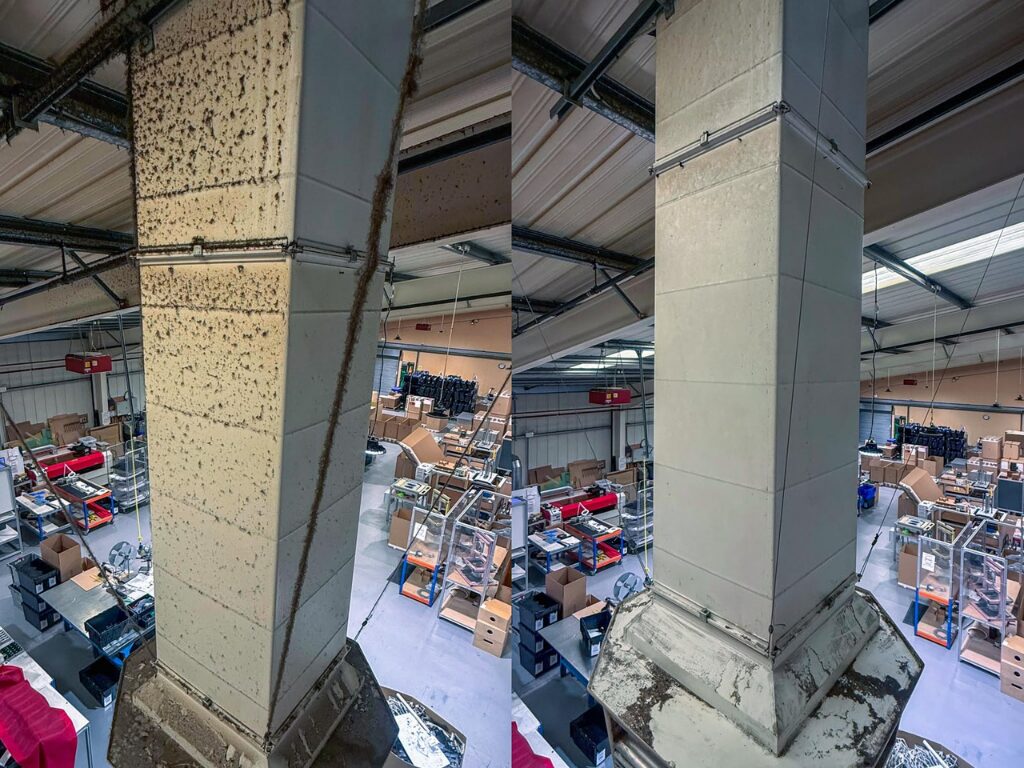
Dust and debris can collect on beams, lighting, ducting, internal cladding and roof-level fixtures. A warehouse may look clean at eye level while contamination continues to build above it.
That matters for safety, audit readiness and general site control.
Warehouse cleaning is therefore usually focused on access, movement and dust management. The aim is to keep routes clear, floors safer, markings visible and high-level areas under control.
Factories are shaped by production
Factory cleaning is different because the risk is usually created by what the site produces.
Manufacturing environments can generate oils, powders, fibres, food particles, chemical residue, production dust or specialist contamination. These materials may settle on floors, machinery, equipment, walls, ducting and structural steelwork.
That makes factory cleaning more closely linked to production processes.
A factory cleaning plan may need to account for machinery access, hygiene requirements, contamination control, maintenance shutdowns, extraction systems and cleaning around sensitive operational areas.
In food production, pharmaceutical, engineering or manufacturing environments, the wrong cleaning method can create more problems than it solves.
This is why standard warehouse cleaning methods cannot simply be applied to a factory environment.
Why this matters for compliance
Compliance depends on the risks present on site.
In a warehouse, the priority may be safe traffic routes, clear floor markings, high-level dust removal and loading bay maintenance.
In a factory, the priority may be production residue, hygiene standards, machinery areas, ducting, extraction systems and contamination control.
If the cleaning plan does not reflect those differences, key risks can be missed.
A generic cleaning schedule may keep the visible areas tidy, but fail to address the parts of the site that matter most during an audit, inspection or incident review.
That is often where problems appear.
Not because cleaning has not happened, but because the wrong type of cleaning has been planned.
Routine cleaning only covers part of the risk
Daily housekeeping is important. It keeps welfare areas, accessible floors and visible spaces under control.
But it does not usually cover the specialist areas that create compliance pressure.
High-level structures, internal cladding, ducting, machinery-adjacent areas, industrial floors and loading bays often need trained operatives, access equipment, RAMS and proper reporting.
These are not extras. They are part of maintaining a safe and compliant industrial site.
For facilities managers, the question is not whether the site looks clean. It is whether the right areas are being cleaned in the right way, at the right frequency.
Documentation is part of the job
For both factories and warehouses, cleaning should be evidenced.
Facilities teams may need to show what was cleaned, when it was cleaned and how the work was carried out. This matters for audits, insurance records, health and safety reviews and internal compliance.
Without documentation, it becomes harder to prove that risk is being managed properly.
A specialist cleaning partner should provide clear scope, RAMS, service reporting and photographic evidence where required.
The right approach
Factory cleaning and warehouse cleaning overlap, but they should never be treated as identical.
Warehouses need cleaning plans built around movement, dust and access. Factories need cleaning plans built around production, residue and contamination control.
Both need structure. Both need specialist knowledge. Both need evidence.
Exterius supports commercial and industrial sites with specialist factory cleaning, warehouse cleaning, high-level cleaning, industrial floor cleaning and planned maintenance programmes.
The right cleaning plan does more than improve appearance. It protects safety, supports compliance and gives facilities teams better control over the site.
If your factory or warehouse needs a more structured cleaning approach, Exterius can help assess the risks and plan the right service.
