Preparing Your Warehouse Floors for Wet Weather Season
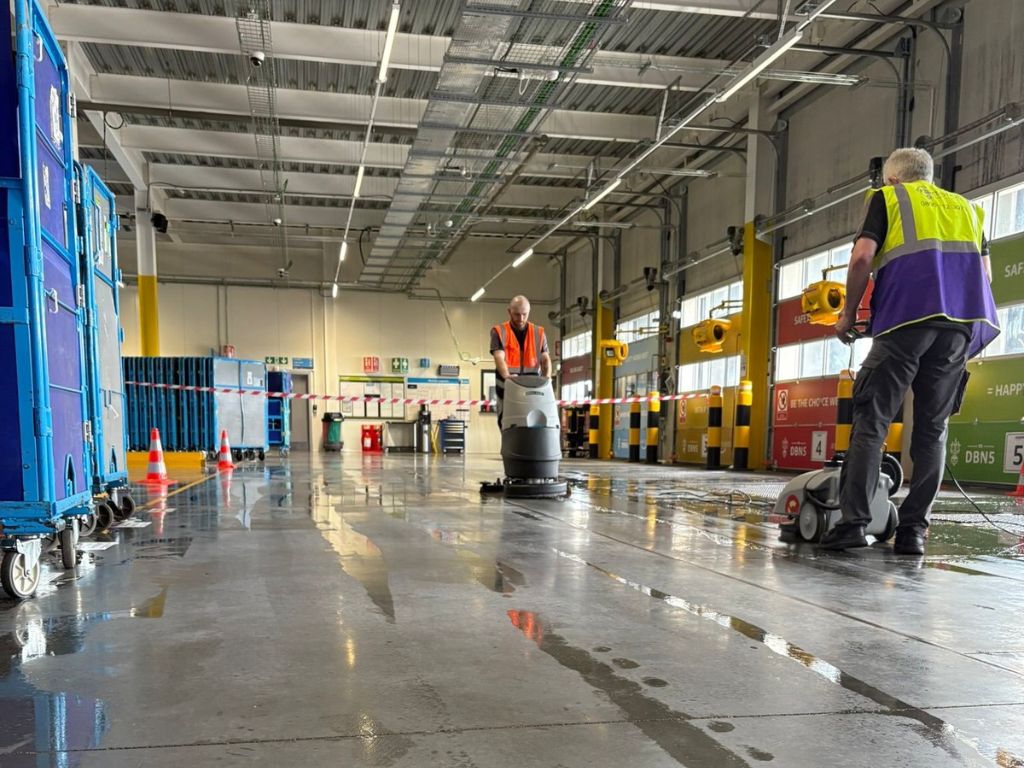
Warehouse floors often see their highest slip risk during wet weather season, not because the floors change, but because what is tracked onto them does.
Rain-soaked footwear, wet pallets, forklift tyres and open loading bay doors can all bring moisture onto surfaces that may already be operating close to their safe slip resistance threshold.
For facilities managers, autumn is the practical window to act — before rainfall, footfall and goods-in volumes all increase together.
This guide covers what changes in wet weather, where the highest-risk zones are, and what warehouse operators should check and treat before the season sets in.
Why wet weather increases warehouse slip risk
A warehouse floor does not need to be outdoors to be affected by rain.
The main risk comes from transition points. These are the areas where external conditions meet internal operations.
Loading bays and goods-in areas are usually the first problem zones. Doors are open more frequently, and wet vehicles, pallets and forklifts bring water directly onto the floor.
Entrance areas and internal walkways are also affected. The first few metres inside any door often see concentrated foot traffic carrying rainwater, mud, grit and residue from outside.
In many warehouses, this happens at the same time as activity increases ahead of Q4 and the winter trading period. More stock movement, more deliveries and more footfall can all increase exposure.
Lower temperatures and shorter daylight hours also mean wet floor areas may take longer to dry between cleans.
A floor that performs adequately in dry summer conditions can become a much greater risk when it is wet for long periods throughout autumn and winter.
Where to focus a pre-season floor check
Before wet weather sets in, the highest-value areas to assess are the places where moisture enters, spreads or collects.
These usually include:
- loading bays and goods-in doors
- main walkways and pedestrian routes
- forklift routes and racking aisles
- entrance lobbies and staff access points
- areas with previous slips or near misses
- transition points between external yards and internal floors
These areas should be reviewed before they become visibly dirty or slippery.
By the time staff are reporting near misses, the risk is already active.
What to check before autumn and winter
The first step is to understand how the floor performs in real conditions.
A Pendulum Test Value assessment can give facilities teams a measurable baseline for slip resistance, rather than relying on visual checks alone. PTV 36 is widely recognised as the benchmark for low slip potential when tested in the relevant end-use condition.
If a loading bay or walkway falls below that level when wet, it should be treated as a priority area for review.
Cleaning schedules should also be assessed. Some products or methods can leave residue that reduces grip over time. A pre-season deep clean can help reset the floor before the wettest months begin, provided the method used does not compromise slip resistance.
Matting should also be reviewed at entrances and transition points. Absorbent matting can reduce the amount of water carried further into the building, but it is not a substitute for a floor surface with adequate grip.
If a floor remains slippery after cleaning and matting improvements, anti-slip treatment may be needed.
Loading bays need particular attention
Loading bays are often the hardest areas to manage during wet weather.
They sit directly between external vehicle movement and internal warehouse operations. They are exposed to rain, oil residue, tyre marks, packaging debris, temperature changes and constant traffic.
If loading bays are not controlled properly, water and contamination can be carried deeper into the warehouse.
That can affect floor grip, obscure markings and make routine cleaning harder to manage.
For this reason, loading bay cleaning, external hard standing maintenance and internal floor cleaning should be planned together. Treating the internal floor without addressing the source of contamination often leaves the main problem unresolved.
When anti-slip treatment is needed
Cleaning can reduce slip risk, but it cannot always solve the problem.
Some warehouse floors become smooth or polished through use. Others have coatings, sealants or finishes that perform poorly when wet. Some areas are simply exposed to moisture too frequently for cleaning and matting alone to be enough.
In these cases, anti-slip flooring treatment can provide a more durable control measure.
This may include a floor grip treatment, anti-slip coating or surface modification depending on the floor type and the way the area is used.
The important point is that the result should be measured, not assumed.
Post-treatment testing helps confirm whether slip resistance has improved and gives facilities teams clearer evidence for health and safety records.
Why timing matters
The worst time to review warehouse floor safety is after a slip, audit issue or operational disruption.
Wet weather risks are usually predictable. If the same loading bays, entrances or forklift routes become slippery every year, they should be treated as known risk zones.
Acting before winter gives site teams time to clean, test, treat and document floor safety before conditions worsen.
It also makes scheduling easier. Anti-slip treatments may need controlled conditions and planned downtime to cure or settle correctly. This is much harder to arrange once wet weather and peak operational periods are already underway.
Planning ahead puts the floor in a stronger position before the highest-risk months arrive.
How Exterius can help
Exterius supports warehouse and industrial sites with specialist floor cleaning, loading bay cleaning and anti-slip floor treatment across the UK.
We help facilities managers identify where wet weather is affecting floors. Contact us for a free site survey today.
