PTV 36 Explained for Slip Resistance Compliance
PTV 36 is widely recognised by the HSE as the threshold for “low slip potential” when a floor is assessed using the pendulum test in the relevant conditions. A floor that tests below PTV 36 may present a moderate or high slip risk depending on the result, the environment and how the floor is used.
For UK employers, facilities managers and property teams, PTV testing provides a practical way to evidence that slip risk has been assessed and managed. It is not a standalone legal requirement written into law as a single number. Instead, it supports broader duties under UK health and safety legislation, including the need to provide suitable floors and manage foreseeable slip hazards.
This guide explains what PTV 36 means, how it is tested, whether it is a legal requirement, and what employers can do to demonstrate better floor safety compliance.
What is PTV?
PTV stands for Pendulum Test Value.
It is the score produced by the pendulum test, a recognised method for measuring the slip resistance of a floor surface.
The test uses a swinging pendulum fitted with a rubber slider to simulate contact between footwear and the floor. The result gives a measurable indication of how much grip the surface provides.
The same floor can perform very differently when dry compared with when it is wet, greasy, dusty or contaminated. That is why the test result needs to reflect the conditions in which the floor is actually used.
A dry reception floor, a wet entrance matting zone, a commercial kitchen, a warehouse loading bay and a food production washdown area should not be assessed in exactly the same way.
What does PTV 36 mean?
PTV scores are commonly grouped into slip potential categories.
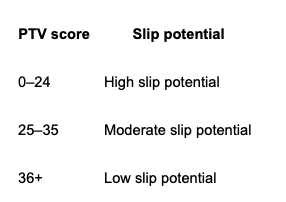
A result of PTV 36 or above is generally treated as the benchmark for low slip potential on level pedestrian surfaces, when tested in the relevant end-use condition.
The final part is important.
A floor that achieves 36+ when dry may still be unsafe when wet. If the area is regularly exposed to rainwater, cleaning residue, oil, grease, condensation, food waste or other contamination, the wet or contaminated result is the one that matters most.
For facilities managers, PTV 36 is useful because it turns “this floor feels slippery” into a measurable result that can be recorded, reviewed and acted on.
Is PTV 36 a legal requirement?
PTV 36 itself is not written into UK law as a fixed numerical requirement.
The legal duty is broader.
Employers and those in control of premises are expected to manage health and safety risks, including slip and trip risks. Workplace floors and traffic routes must be suitable for their use, kept in good condition and kept free from substances that may cause people to slip, trip or fall.
PTV testing helps provide evidence that those duties have been considered.
In practice, this means:
- PTV 36 is not a standalone legal rule
- PTV testing is a recognised way to assess slip risk
- results below 36 may indicate a moderate or high slip potential
- employers should take action where a floor presents a foreseeable slip risk
- documentation matters if there is an audit, inspection, incident or insurance claim
The key question is not only whether a floor has been treated.
It is whether the risk has been identified, measured, controlled and documented.
When should employers consider PTV testing?
PTV testing is most useful where there is a known or suspected slip risk.
This may include:
- entrances that become wet during bad weather
- commercial kitchens and food preparation areas
- warehouses and loading bays
- factories and production areas
- washdown zones
- chiller units and cold storage areas
- leisure centres, spas and swimming pool areas
- healthcare environments
- schools and universities
- retail spaces and shopping centres
- external walkways, ramps and car parks
It is also useful after a slip incident, near miss, flooring change, anti-slip treatment or cleaning regime change.
If a site has recurring concerns about slippery floors, testing gives facilities teams a clearer starting point.
What should employers do if a floor tests below PTV 36?
A result below PTV 36 does not automatically mean the floor has failed a legal test.
It does mean the floor may present a higher slip potential and should be reviewed as part of the site’s risk management process.
The next step depends on the cause of the issue.
In some cases, the problem may be contamination. Dust, grease, oil, cleaning product residue or moisture may be reducing grip. Improving the cleaning process may help.
In other cases, the surface itself may not provide enough grip for the way the area is used. Smooth tiles, polished stone, sealed floors or worn commercial flooring can become slippery when wet or contaminated.
Where cleaning alone is not enough, anti-slip floor treatment may be needed.
This might include a floor grip treatment, anti-slip coating, surface modification or another suitable control measure.
The important point is that action should be proportionate, documented and based on the conditions of the site.
Why “wet PTV” matters
Many slip incidents happen because a floor performs well when dry but poorly when wet.
This is common in entrances, tiled areas, kitchens, washdown zones, changing rooms, cold stores and external routes.
For that reason, facilities managers should pay close attention to how the floor performs in realistic conditions.
A surface that is regularly wet should be assessed as a wet surface. A warehouse floor exposed to oil or dust should be assessed with that contamination risk in mind. A chiller floor affected by condensation should not be treated as a standard dry indoor floor.
PTV testing is only useful if it reflects the environment people actually walk through.
Does anti-slip flooring guarantee PTV 36 compliance?
Anti-slip flooring or anti-slip treatment can help improve slip resistance, but the evidence comes from testing.
A product claim alone is not the same as a measured result on your floor.
For a defensible compliance position, employers should consider testing before and after treatment, especially in high-risk areas. This helps confirm whether the treatment has improved the floor’s slip resistance and whether the result is suitable for the way the area is used.
It also creates a record for health and safety files, insurance purposes, landlord requirements or internal compliance reporting.
How Exterius can help
Exterius provides commercial and industrial anti-slip floor treatment across the UK.
We support facilities managers, property teams, employers and FM companies with practical solutions for slippery floors, including MicroGrip etching treatment and UVGrip clear anti-slip coating systems.
Our anti-slip solutions can support:
- commercial entrances
- warehouses and loading bays
- factories and production areas
- food production sites
- commercial kitchens
- cold storage and chiller units
- healthcare and education environments
- leisure and hospitality sites
- retail and public-facing spaces
The right solution depends on the surface, the environment, the contamination risk and the level of traffic.
Anti-slip flooring is not just about making a floor feel safer. It is about improving grip, reducing foreseeable risk and giving employers better evidence that slip hazards are being managed properly.
If your floors become slippery when wet, or you need to improve slip resistance as part of a wider compliance programme, Exterius can assess the surface and recommend the right treatment.
FAQs
What PTV rating is considered safe for a commercial floor?
PTV 36 or above is widely recognised as the benchmark for low slip potential on level pedestrian surfaces when tested in the relevant end-use condition. Wet or contaminated areas may need further assessment depending on the risk.
Is PTV testing a legal requirement in the UK?
PTV testing is not specifically named as a legal requirement in itself. However, it is a recognised way to assess and evidence slip resistance as part of wider workplace health and safety duties.
Who is responsible for PTV compliance in a commercial building?
Responsibility usually sits with the employer, occupier, facilities manager, building owner or the party in control of the premises, depending on the site arrangement and who manages the floor area.
How often should floors be PTV tested?
There is no single fixed interval for every site. Testing is usually considered after installation, after anti-slip treatment, following incidents or near misses, and periodically in high-traffic or wet areas where slip resistance may decline over time.
Does anti-slip flooring guarantee PTV 36 compliance?
No. Anti-slip treatment can improve slip resistance, but the result should be verified through testing. The compliance evidence comes from the measured performance of the floor, not the fact that a treatment has been applied.
What should I do if my floor is slippery when wet?
Start by assessing why the floor is slippery. Cleaning, drainage, mats, maintenance, anti-slip treatment or a clear anti-slip coating may be needed depending on the surface and the way the area is used.
